
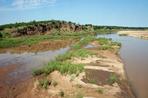
About Southern Mopaneveld
Engelhard Dam
Letaba Area
Letaba Camp to Mozambique
Letaba to Mopani
Letaba to Olifants
Olifants Area
Palaborwa Gate Area
Phalaborwa to Letaba
Phalaborwa to Mopani
See Kruger Park Olifants Area Self-drive Map
Masorini to Letaba (H-9)
For 20km after Masorini, the main road to Letaba Rest Camp takes one through fairly monotonous mopane flatland with not much game. There are, however, an extraordinary number of termite hills in this part of the Park. One will notice that the termite hills are at least 50m apart, because these insects are fiercely territorial.

Termites
Termites are a crucial part of the savanna ecosystem in that they break down dead and decaying plant material and recycle it as nutrients. Scientists believe that termites consume over 50% of surface plant litter in the African savanna and that 20% of carbon produced in this habitat is due to termite activity.
In Kruger termites are believed to eat about 20kg of plant material per hectare per year. In northern Kruger there are an estimated 1,1 million active termite mounds, or approximately a mound every hectare. The bigger termite mounds in Kruger have populations of over 200 000 termites. Besides their role in recycling energy, they are an important food source for many animals.

A termite mound can be occupied by successive generations of termites for centuries. During summer, one may be lucky enough to witness gatherings of eagles above the mounds, preying on high-flying termites, which are rich in protein.
Another animal that feeds on termites is the rarely seen aardwolf ("earth wolf" in Afrikaans), a member of the hyaena family, which has such sensitive hearing that it can detect termite activity deep under the ground.
The Aardvark uses its long tongue to lap up termites when they find them, and a single animal is capable of eating up to 300 000 insects during a night's outing.
Elephant Behaviour

Each Kruger elephant pushes over up to four trees a day - sometimes to get at the leaves, sometimes for no apparent reason. Most trees re-sprout with only a fraction being killed.
Naturalist Bob Scholes estimates there are about 300 mature trees per hectare in Kruger, and that elephants destroy one percent of Kruger's trees per year.
The eastern grasslands have been worst affected with up to 60% of tree cover disappearing over the past 50 years.
 A green and thriving oasis, Letaba Rest Camp offers comfortable accommodation in Kruger Park with excellent Elephant and bird viewing opport...
 Phalaborwa Gate offers an interesting landscape; granite stands forms a series of kloppies that have been used as navigational landmarks for...