
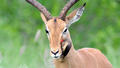
What is an Antelope?
Antelope are herbivorous even-toed animals of the Bovidae family with social structures ranging from the solitary Steenbok to the very social Wildebeest. Kruger Park has a strong antelope population with larger species such as Sable antelope found in mixed savannah woodlands around Pretoriuskop and also near Phalaborwa and the Roan in the open grasslands in north-eastern Kruger.What is pronking?
Stotting, also known as pronking, is a gait used by gazelles where they jump high in the air with all feet off the ground. Pronking is used to describe this behaviour in Springbok of southern Africa and comes from the Afrikaans word 'pronk' which means to strut or show off.
Do Antelope mothers abandon their young often?
Some antelope mothers leave their young hidden from predators when the mothers go out and feed. In some cases such as the Impala the mothers leave their young in nursery herds that are cared for by adults. These two examples may give the impression that antelope mothers abandon their young.
Do Antelope horns re-grow?
Horn re-growth in antelope does not generally occur. If the horn breaks off completely there will be no chance of regrowth but if the animal is young and the horns breaks somewhere along the shaft there may be some form of growth, although the growth will more than likely be deformed.
What is the difference between Gazelle and Antelope?
A Gazelle is a genus of the Antelope group with only one species occurring in Southern Africa - the Springbok. A surprising fact is that the Springbok does not occur in the Kruger National Park.
What is a Sprinbok?

Not to be confused with the South African Rugby team of the same name - the Springbok is a medium-sized antelope that gets its name from the fact that it can leap high in the air. This is known as pronking. Learn more about the Springbok
African Antelope Guide

Want to learn more about Antelopes in Africa? Find out more about Kudu, Eland, Sable Antelope, Roan Antelope, Impala, Nyala, Bushbuck, Blue Wildebeest, Duiker and many more in our Kruger Park Antelope Guide
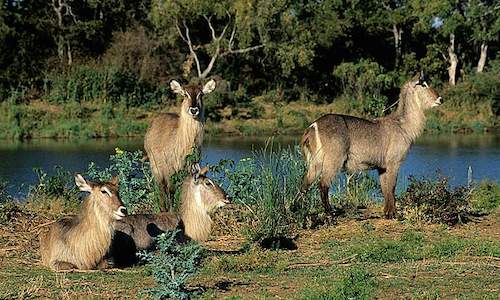 Antelope Guide - Most of Africa's herbivores can be classified as either grazers of grass or browsers of leaves off trees. Kruger Park Antel...