
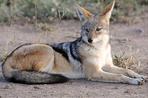
Jackal


Black-backed jackals are nocturnal, dog-like scavengers and predators with pointed ears and faces. Reputedly carries rabies, but in fact ultimately dies from the disease.

Black Backed Jackal - Appearance

Males attain a height of 400 mm at the shoulder, and weighs seven to ten kg. The erect and pointed ears are a prominent feature. The fur consists of long, dark hair on top of the neck and back. Their flanks and face are beige-buff, sometimes rusty-reddish, they have a black tipped tail. The black-backed jackal is one of two jackal species found in South Africa, the other being the side-striped jackal.

Diet

As an omnivore it eats almost anything that is available including insects, lizards, rodents, plant materials and carrion. As such it assists in maintaining the ecological balance. It scavenges when carcasses are available. They co-operate in larger groups to subdue larger prey, such as impala and wildebeest calves. They play an important role in removing sick and old animals from populations. Caches small chunks of meat when in abundance, for later use. They will also prey on poultry and small stock.

Breeding

Mating occurs between June to August, thus it is a seasonal breeder. After a two months gestation period, between one and six pups are born from August to October. Peak breeding season can vary regionally. Pups are suckled initially and thereafter fed on regurgitated food for up to three months, thereafter young are able to forage with the adults.

Behaviour

Socially monogamous, a pair of jackals bond for life. The young initially use their parents territory to gain survival experience and also to assist in raising more recent litters. Later in life they undertake wide ranging excursions until they find their own mates and territories. Black-backed jackals have a well-developed communication system.

Habitat

Found throughout the country in open ground or light woodland. It has a wide habitat tolerance, but is absent from dense forested areas.

Where they are found

Widespread in east and southern Africa. In the north, it is found from the Gulf of Aden south to Tanzania. In the south, the population ranges from the Cape north to southwestern Angola and east to Zimbabwe and Mozambique.

Side stripped Jackal - Appearance

Nocturnal, dog-like carnivores, with a head and body length of 650-800 mm and tail length of 300-400 mm. Shoulder height 400-500 mm, mass 7-12 kg. They are timid and rarely seen. They are larger than the black-backed jackal. They have a grey to buffy body, with a darker back. The sides are marked with a white stripe with black lower margins. The dark tail is almost always tipped with white, whereas the ears are a dark buffy colour.

Diet

The success of this omnivorous species can be attributed to its ability to live off a wide variety of food, changing its diet in response to environmental conditions. Its diet includes small mammals, carrion, fruits, maize, reptiles, eggs and birds. Side striped jackals are less predatory than the black-backed jackal.

Breeding

Mating normally occurs during June-July, but some mating may take place throughout the year. After a gestation period of 57-64 days, four to six pups are born during August to November. Assistance with the rearing of pups is rendered by the previous year’s offspring. Excavated termitaria and old Aardvark burrows are commonly used as dens. Both parents assist with rearing the young after weaning. They bring food to the pups in the mouth or regurgitate it at two to three hour intervals throughout the night. During the breeding season a pair remain in close proximity.

Behaviour

They are a highly territorial species, and each territory is held by a monogamous pair and their recent offspring. Offspring will eventually disperse an find their own territories.

Where they are found

In South Africa their distribution stretches from Northern KwaZulu-Natal to Mpumalanga, the Northern Province and Swaziland. The side striped jackal inhabit open plains.


Reference Guide Navigation
You are currently on page number 6
