
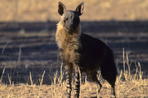
Brown Hyena - Appearance This creature has pointed ears and striped legs with a dark brown to black shaggy coat, white shoulders and neck. It stands 800 mm at the shoulder and weighs 40 Kg. They have a long cream-coloured mane which extends from the back of their neck across the shoulder bones. The head and neck, are grey, and the legs, are covered with brown and grey bars.
DietThe Brown Hyena is a carnivore which has adapted to a scavenging lifestyle. It will however, supplement its diet with insects, birds eggs and wild fruits and even occasionally kill small animals. The Brown Hyena is mainly a scavenger, feeding upon carcasses of large herbivores killed by other animals. Their jaw and dentary adaptations allow them to break open the long bones of these large animals and feed on the marrow inside. Breeding Brown Hyenas are non seasonal breeders and have a gestation period of about 90 days. Females give birth to 1 to 4 young. Young are suckled for more than a year and live in the den for up to 18 months. Mother’s milk is supplemented with meat from three months of age. At birth Brown Hyena have the same body colouration as adults and reach full size by 30 months.
Behaviour They are solitary and nocturnal, lying during the day in thick bush or in deserted Aardvark burrows. Brown Hyena live in small clans ranging from a breeding pair and their young to groups of several mature males and females. The clan cooperatively defends a territory, but do not forage together.
where they are found In South Africa they are found in the southern savannahs, grasslands, semi-deserts and deserts. It is an extremely retiring animals, as illustrated by the fact that it still persists north-west of Pretoria in the Magaliesberg mountain range. Brown Hyenas are a common sight along the Skeleton Coast, where they feed on detritus washed from the Atlantic ocean. They tend to avoid areas frequented by the spotted Hyena.

Latin nameParahyaena brunnea. Spotted Hyena - Appearance The Spotted Hyena is well known for its macabre chuckle or “laugh”, which is an indispensable sound of the African bush at night. The large head, sloping back and a keen sense of smell is unique to this species. Females dominate the social hierarchy and are larger than males. Females are 850 mm heigh at the shoulders and weigh 70 kg, whereas males weigh in at 60 kg. The spotted hyaena is yellow with dark spots and round ears. Externally female genitalia superficially mimic the male reproductive organs, thus making gender identification difficult.
DietSome experts would argue that the spotted hyaena is Southern Africa’s most successful carnivore, and considering its social structure certainly one of the most interesting. It has been regarded as cowardly in the past, but detailed field studies have revealed it to be an efficient, powerful predator. It would scavenge by choice, and a pack of hyaenas would drive lions off their kill to gain access to the spoils. However, clans of hyenas are also formidable hunters and are more than capable to take care of their nourishment requirements. They prey on other animals and their young, as well as eating carrion. They can pursue their prey at 60 km/hr for up to three km. Prey such as Buffalo, Eland and the potentially dangerous rapier-horned Gemsbok can be overcome by a pack of hunting spotted hyaenas.
Breeding Young may be born at any time of the year. The gestation period is 3-4 months, and there are usually 2 young per litter. The cubs weigh over 3 pounds at birth. They are not weaned for 12-16 months. No food is necessary during this time, since they receive enough nourishment from their mother's milk. Cubs are raised in communal dens, but seldom provisioned or guarded by clan members. Males play no parental role, only a privileged few are permitted anywhere near dens, where even juvenile offspring of high-ranking females dare to bully them. The dominant male will father most of the offspring in the group.
Behaviour They are nocturnal, lying during the day in thick bush or dens which are usually deserted Aardvark burrows. Hyaenas live in clans defending their territory against other clans. Members continuously dissolve clans and form new ones with fellow clan members and those of other clans.
HabitatThey prefer dry savannas, open plains, and semi-arid scrub. Where they are found Extinct over most of South Africa except in central savannah and Skukuza in the Kruger and Kalahari Gemsbok National Parks, Northern Province, and the northern regions of KwaZulu-Natal.
Latin nameCrocuta crocuta. |