
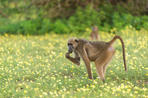
Appearance The baboon (papio cynocephalus ursinus) is a large primate with a dog-like face and big, prominant canines. A mature male measures 1.5m from head to tail and weighs up to 33 kg, whereas the more slender female measures 1.1m and has a mass of about 15 kg. It has beady, close-set eyes under a heavy brow, and a dog-like muzzle with sharp tusk-like upper canine teeth. Its muzzle is bare, as is its rump under the tail.
They are very hairy animals with olive-gray fur. Its fur sticks up all over its body. They walk on all 4 feet with their tails held in a crooked arch over their back. Their tails are around 2 feet long. The females have a large red bottom which is a sign to the males when they are ready to mate. DietBaboons are omnivorous. They feed on lizards, birds and their eggs. They might kill the new borns of some Antelope and even Leopard cubs. The Chacma Baboon feeds on just about every part of a tree. They eat grass, seeds, rhizomes, berries, mushrooms, fruit, eggs and small animal-like insects, earth worms, birds, lizards, and less occasionally they will kill and eat scrub hares and baby Impalas. Breeding Baboons do not have a definite breeding season and are sexually active throughout the year. Females give birth to a single young after a gestation period of about 6 months, not mating again for the following 18 months. Females will give birth to their first young at the age of about 4.
BehaviourThe Chacma Baboon has a multimale-multifemale social system. This species has a promiscuous mating system. There is much aggression between males because of competition for females. Males disperse from their natal groups, and females are philopatric. A linear hierarchy exists within the group based on the matriline. Associations between males and females are important because when a male first tries to join a group he might have a difficult time, so an association with a female could help him.
Male aids in the rearing of the infants in terms of carrying and grooming, and will come to the defence of their female when attacked by members of another troop. Male consorts will even become foster parents when the mother dies.
Adult males may act aggressively towards troop members if they lag behind when the troop is moving rapidly. They have a 2 phase bark; this is a deep, loud call which is repeated at 2 to 5 second intervals. This sounds like 'wahoo' and is emitted by adult males. This call is emitted when a predator is near especially a feline one. This call is also heard when there is inter or intra group aggression between males. This call communicates male presence and arousal. Their vocal abilities include grunting, screeching, yakking, clicking, chattering and growling. Baboons live in troops of up to 50 to 100 individuals, congregating at night in a chosen tree or cliff, where they sleep, and from which they descend in the morning to look for food. They never travel too far from their sleeping spots, not more than one or 2 kilometres, but they normally have more than one of these sleeping-sites, within their territory, that they use on a rotation basis. Baboons are diurnal and are always on the move so they don't strip an environment of it vegetation.
They will normally have home ranges and will only show defensive behaviour around their sleeping sites. These sites usually have a strong smell of dung and urine around them. Different troops may sometimes use another troop's sleeping site while they are in the area. They will spend hours grooming each other, picking off bits of skin, ticks and fleas, as well as licking salt from each others bodies. HabitatBaboons inhabit woodlands, semi-deserts and sub alpine meadows along the Drakensberg. They spend most of their time on the ground. The only time they go into trees is to escape predators, get food, or spend the night. They might also spend the night on tall rocky outcroppings. Baboon babies usually go up in trees to around and play with each other. The Chacma Baboon is replaced in the north by its close relative, the Yellow Baboon. Where they are found Baboons live mostly in the African woodland savannah, and highland grasslands. They never wander far from trees, or a source of water. The Chacma Baboon is found in the countries of Angola, Botswana, Mozambique, Namibia, South Africa, Zambia, and Zimbabwe. Availability of water usually limits where they live.
Predators Baboons are preyed upon by Lion, Hyena, Leopard, Cheetah and Python.
|
