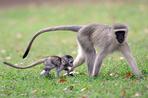
Monkey

Monkey jumping from a tree branch.


Introduction

Unlike many tropical African countries, there are only two monkey species in South Africa, namely the vervet and the Samango monkey. Both are fruit eating tree dwellers, as a consequence of which they can inflict serious damage to commercial fruit orchards.

Appearance - Samango Monkey

Males are larger than females, males have a mass of 7 to 9 Kg and females 4 to 5 Kg. The tail is a third longer than the body. The coat of the head and the shoulders is dark grey to black. Facial skin, feet, hands and lower limbs are black. Upper limbs and flanks are paler than the shoulders. Belly and throat are a creamy white. The muzzles of males protrude to accommodate the enlarged canines.

Diet

The diet of the Samango Monkey include fruits, insects, flowers, leaves and insects. The Samango male consumes more fruit than the female. While foraging for food it would appear that Samangos start the day by selecting for fruit, and will later in the day take leaves, whereas the day is finished with a combination of fruit and leaves.

Breeding

This primate is a seasonal breeder. Females give birth during the onset of the warm, rainy season. A single young is born after a gestation period of 140 days. Young are carried by their mothers for two to three months, and are finally weaned at the age of nine months. Males compete for the attention of oestrus females. In Samango troops, oestrus is unsynchronised.

Behaviour:

Samango Monkeys have a harem social structure, that is a single dominant male lives with his females and their infants and subadults. The social core is formed by related females, who will also defend their territory.

Habitat:

Can survive in relatively depauperate swamp forests, inclusive of the deciduous sand forests of northern KwaZulu-Natal, although it is mainly confined to evergreen indigenous forests. Seldom ventures into forest patches smaller than 50-100 ha.

Where they are found:

Not widespread or common in South Africa, occurring only in the coastal forests north of St Lucia estuary in KwaZulu-Natal, and in the Afro-montane forests of Mpumalanga. The range extends into similar habitats in neighbouring countries. Another, more southern subspecies, is found in Afro-montane and coastal scrub forests of central and southern KwaZulu-Natal, extending into  the Eastern Cape to just north of the Knysna forest. Higher population densities occur at the north coast. The two South African subspecies are only distinguished by colour variances.

Appearance - Vervet Monkey

Males have a mass of six kg and measure 1.1 m in length, whereas females are slightly smaller and weigh only four kg. Vervets have a silver-grey body with a marked black face. The ridge of the eyebrows is white, and so are the feet and tail tip. The genitals of adult males are vividly coloured to signal sexual status, namely a red penis and a blue scrotum.

Diet:

The diet tend to be omnivorous, feeding on fruit, flowers, leaves and insects, which constitutes the bulk of their diet. Primates are amongst the few mammals with colour vision, which allows vervet monkeys to distinguish between green and ripe fruit.

Breeding

This is a seasonal breeder and single young are born between March and May after a gestation period of 140 days. Interbirth intervals could be longer than a single season, and is correlated with food abundance.

Behaviour:

Vervets are highly social animals, and occur in well organised troops, dominated by males. Females do not leave their natal group, but males emigrate from the troop at puberty. Access to prime food recourses is determined by the dominance hierarchy.

Habitat:

A sufficient density of tall trees  and the availability of permanent surface water, allow this primate to occur in a wide variety of macro environments. Regarded as primarily a forest edge specialist.

Where they are found:

Unlike many tropical African countries, there are only two monkey species in South Africa, namely the vervet and the samango monkey. Both are fruit eating tree dwellers, as a consequence of which they can inflict serious damage to commercial fruit orchards. The vervet monkey is common throughout South Africa, and occurs wherever essential habitat requirements are met. The out of control expansion of wattle trees made it possible for the vervet monkey to extend its historical range.


Reference Guide Navigation
You are currently on page number 2