
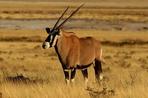
Appearance A large antelope with striking black and white markings on the face and legs, black side stripes on the flanks and a long black tail. Bulls measure 1.2m at the shoulders and attain a mass of 240 Kg. Both bulls and cows have horns. Male horns are shorter and stockier than female horns.
DietGemsbok mostly feed on nutritious leaves, grasses and herbs. During the dry season they feed on flowers and will also browse for food. To supplement water requirements gemsbok dig for succulents and extensively eat tsama melons. Breeding Although the Gemsbok does not have a specific breeding season. Usually only one calf is born after a gestation period of approximately 9 months. Mating takes place between receptive females and the dominant male of the territory.
BehaviourFemale herds, including non-territorial bulls, in search for fodder will move between the territories of dominant bulls. To avoid conflict non-territorial bulls are submissive towards aggressive challenges from territorial bulls. The behaviour of this species is geared to energy and water conservation. In the heat of the day they will lie-up in the shades of trees. Where shade is not available they will orientate themselves to present as little as possible of their body surface to the sun. Lone bulls are common and have been known to kill attacking lions by impaling them with their strong horns. Habitat Preferred habitat is arid open grasslands, but they will also utilize a diversity of habitats like western Namib rocky areas, sand dunes of the Namib Desert and the Kalahari semi-desert plains.
Where they are found Gemsbok are to be found in many game reserves throughout South Africa and have been successfully re-introduced to areas where they once roamed and became extinct.
PredatorsLions, Leopards, Cheetahs, Spotted Hyenas and Wild Dogs prey upon the Gemsbok and calves are especially vulnerable, accounting for their very high mortality rate. Latin name Oryx gazella.
|
