
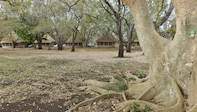
The idyllic Letaba Rest Camp is situated on a sweeping bend of the Letaba River, midway between the southern and northern boundaries of the Kruger National Park, South Africa.
The character of Letaba Camp depends heavily on the tall shady trees (Sycamore Fig, Natal Mahogany, Sausage Tree and Apple Leaf), expansive lawns and indigenous gardens where tame Bushbuck wander. Visit in winter and you will find the gardens a riot of colour, with several species of Aloe and the Impala lily in full bloom at your accommodation in Kruger Park. The Aloes attract a variety of birds, including the White Bellied and Marico Sunbird, Crested Barbet, Blackheaded Oriole and Black Eyed Bulbul.
Getting There

Where is Letaba Rest Camp?
Letaba Rest Camp is located in the central northern part of Kruger National Park on the bend of the Letaba River.
What is the closest Kruger Park entry gate to Letaba Rest Camp?
Letaba Rest Camp is 51 km from Phalaborwa Gate.
What is the closest airport to Letaba Rest Camp?
Gateway Airport in Phalaborwa (3km from Phalaborwa Gate) is the closest airport to Letaba Rest Camp.
How long does it take to drive to Letaba Rest Camp from Johannesburg?
The drive from Johannesburg to Phalaborwa Gate takes about 6-7 hours followed by another 2 hour drive (51 km) to Letaba Rest Camp.
What is the GPS coordinates of Letaba Rest Camp?
-23.854156, 31.574433
Facilities

What facilities does Letaba Rest Camp have?
- Information at Reception
- Public telephone
- ATM
- Post box
- Basic first aid assistance
- Swimming Pool
- Cutlery and plates hampers (from Reception)
- Restaurant
- Cafeteria
- Shop
- Petrol station
- Laundromat
- Communal kitchen
- Communal bathroom
- Limited DSTV only available in Guest Houses
- Cellphone reception
- Conference facilities
- Day Visitors picnic area on the perimeter of the camp with own swimming pool
Accommodation

Where can I stay at Letaba Rest Camp?
Letaba Camp comprises of guest houses, cottages, bungalows as well as huts, tent and caravan sites and furnished safari tents to choose from. All units are serviced daily and supplied with bedding, towels and soap.
The fifth largest rest camp in the park, Letaba Camp has a wonderfully relaxed atmosphere. The units are comfortably spread out in spacious semi-circles facing the wooded lawns and the river beyond.
Accommodation Types
- Huts
- Bungalows
- Cottages
- Safari tents
- Guest Houses
- Camp Sites
See more Letaba Rest Camp accommodation
Dining

Where can I eat at Letaba Rest Camp?
Letaba Rest Camp offers several dining options for guests. By day, the cafeteria provides a casual, grab-and-go setting ideal for breakfast before a sunrise game drive or a light lunch between safari adventures.
Tindlovu Letaba Restaurant serves breakfast, lunch and supper overlooking the Letaba River floodplains, allowing diners to watch wildlife wander by.
When in the mood for something more communal and relaxed, guests can book the boma braai - an outdoor barbecue enclosure seating around 50 people, where traditional meals are served under the stars.
Accommodations at Letaba Rest Camp either have a private kitchen or communal kitchen as well as braai facilities.
Wildlife

What wildlife can I see around Letaba Rest Camp?
Letaba means 'river of sand' and the sandy riverbed makes for great game viewing, particularly Elephant, Waterbuck and Buffalo which abound in the area.
Being close to 3 major dams, provides for excellent wildlife viewing. Letaba is a green oasis in the surrounding mopane veld, and remains a firm favourite with holiday visitors for accommodation Kruger Park. Other animals around camp include Squirrels, Fruit Bats and Vervet Monkeys.
Letaba Rest Camp offers excellent bird watching opportunities all year round. Pearl-spotted, Barred and Scops owl can be spotted in camp, while the Giant Eagle Owl is regularly recorded along the river. Green Pigeon and Brown-Headed Parrot can be found high in the tree canopies.
Activities

What activities can I do at Letaba Rest Camp?
Guided game viewing at Letaba Rest Camp include sunrise and sunset game drives, as well as morning and afternoon bush walks led by expert ranger-guides that bring you close to elephants, buffalo, waterbuck and even the occasional lion or cheetah .
For bird-lovers, the Matambeni Bird Hide beside Engelhardt Dam (10 km north of camp) is a must-visit vantage point to spot egrets, kingfishers and sunbirds
Elephant Hall is worth a visit - this small but compelling museum is filled with tusks from Kruger’s legendary 'Magnificent Seven', along with animal skeletons and anatomical displays.
There’s also a self-guided riverside trail perfect for a stroll around Letaba Rest Camp. Or spend your free time taking a dip in the swimming pool, or have a casual braai by the restaurant overlooking the river.
See more Letaba Rest Camp activities
History of Letaba Rest Camp

In prehistoric times, parts of the present-day Kruger National Park were inhabited by successive groups of people. One such example is that of picturesque Masorini Hill which is 39km (24 miles) from Letaba.
Human habitation at Masorini has been traced back several centuries to the late Stone Age, while more recently it has been home to the BaPhalaborwa tribe's people who inhabited it in the early 19th century. They were cattle and crop farmers, as well as iron smiths of note, who made a living by manufacturing iron artifacts and trading with Arab merchants on the east coast.
Archaeological excavations have revealed hut floors, packed stone walls and terraces, grinding stones, pot shards, glass beads, ash and even food remains. Most impressive, however, are the iron-melting furnaces, smithies and worked artifacts. The village offers an example of a specialized economy and well-developed technology that existed well before the arrival of the white man in South Africa.
The origin of a typical Portuguese cross, carved into an old leadwood tree along the S95 road just north of Letaba, remains shrouded in mystery. It may have been carved by the Portuguese explorer, Ferdinandes das Neves, during his expedition to the Soutpansberg in 1860-61.
