
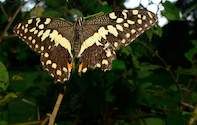
Many butterflies are gender dimorphic, what does that mean? It means that the males and the females look different from each other. We find it in humans too. Yet in butterflies it is expressed mainly on the wing colour and pattern. The bodies are obviously also different - isn't that what the French appreciate about the female body? Yet it is the wings that are the most striking and it is here that one can quickly identify a butterfly.
In the mocker swallowtail (Papilio dardanus cenea) the male is a striking yellow specimen with long tails, as the name implies, swallow-tails to be precise. This sub-family of butterflies has the derivation of the original French name - papillion. This sub-family has some of the largest and most striking butterflies.
The male is readily attracted to sip at the cup of ambrosia found in flowers. It will dart from flower to flower, looking for nectar. When it has replenished its thirst or the nectar supply it will jet off again at a speed in search of more flowers or a female. The female mocker swallowtail has no tails and has several different forms. They vary in colour from white and shades of yellow and orange on a black ground colour. She has a slower flight pattern and busies herself quietly looking for flowers with a much more peaceful demeanour of going about her daily activities.
Many butterflies are gender dimorphic and it perhaps has to do with identifying the species and the gender. Often butterflies are 'harassed' by other butterflies that dive-bomb them, just to find out it is not a female of choice. This especially happens to the white butterflies or Pierids. Perhaps due to there being so many white butterflies.
It seems that the butterfly first recognises a prospective mate from a distance by colour and then when closer to the subject, the smell of pheromones or perhaps a distinctive species smell has some greater influence of conviction. Butterflies like the large vagrant (Nepheronia argia), African migrant (Catopsilia florella) and Buquet's vagrant (Nepheronia buquetii) are extremely similar in wing colour and pattern, therefore the 'sniff' test may be the way to go. If dogs can do it... Some butterflies are exactly similar, but differ in size.
The female is usually larger with a stouter abdomen. One such example is the pirate (Catacroptera cloanthe cloanthe). Some butterflies also show seasonal dimorphism - meaning they look different in the different seasons. A prime example of that is the gaudy commodore (Precis octavia sesamus).
The summer form is bright red, while the winter form is a distinctive blue. Experiments have shown that if the pupa is put below a certain temperature for a sustained period, the butterfly will assume the winter form, whereas a warmer temperature will produce a summer form. Fluctuating temperatures tend to have intermediate forms as a result. Whether butterflies tell the difference by sight, smell or temperature, the fact remains that they can do it. Vive le difference!
By Herbert Otto
 There are several butterflies that occur throughout the Kruger National Park and also many that occur throughout the year. Granted, these bu...