
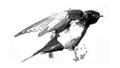
There are only about 1 000 Blue Swallow, breeding pairs left in the world. Loss of suitable habitat due to land use change is the main reason for this decline. The bird breeds in South Africa's mist-belt grasslands and is a flagship species for the Endangered Wildlife Trust (EWT)'s Threatened Grassland Species Programme.Grasslands are possibly the most threatened biome in the world, with a mere 1.4 percent being formally protected. Grasslands are also one of South Africa's most threatened ecosystems with only 2.2 percent formally conserved and some 60 percent already irreversibly transformed. The major threats facing them are urban development, mining, forestry, agriculture, invader species, overgrazing and inappropriate fire management.Blue Swallows rely on mistbelt grasslands in particular for their survival, both as foraging areas and for nesting throughout their summer breeding season. In South Africa, these grasslands are found at medium to high altitudes (750 - 1 900 meters above sea level) along the north-eastern escarpment formed by the Drakensberg, with high rainfall and frequent advection fog. In these areas the swallows breed in existing holes such as Aardvark Orycteropus afer burrows, old mine shafts and sinkholes. They make their nests out of mud and grass and lay two to three eggs, which are incubated for about 14 days. The chicks then spend 22-26 days in the nest before fledging. Current numbers show fewer than half a dozen breeding pairs in Mpumalanga and fewer than 40 pairs in the country as a whole.In order to protect the Blue Swallow's habitat, the Blue Swallow Natural Heritage Site, KwaZulu-Natal Mistbelt Grasslands and other areas have been declared by BirdLife South Africa as Important Bird Areas to protect the remnant populations of this attractive swallow.The specimen's breeding range is spread across eight countries: Zimbabwe, Malawi, Swaziland, Mozambique, Zambia, southern Tanzania, south-eastern Democratic Republic of Congo and South Africa. The birds arrive in their breeding areas in early September and depart for warmer parts of Africa in early to mid-April. They spend the rest of the year in their non-breeding range spanning four countries: Kenya, Uganda, north-western Tanzania and north-eastern Democratic Republic of Congo.Recent studies suggest that the Blue Swallows we see in South Africa actually fly all the way to Uganda during the non-breeding season. To confirm this, the EWT is planning an expedition in June 2011 to catch a few swallows in Uganda and collect feather samples. The feathers have regionally distinct stable isotope signatures, determined by the food that the bird was eating while the feather was growing. By analysing feather samples it is therefore possible for scientists to tell where the birds that are wintering in Uganda spend their summers. It is important to know where South Africa's Blue Swallows spend their winter in order to conserve both their summer and winter habitat.A team of researchers from the EWT, FitzPatrick Institute, University of Pretoria and Council for Scientific and Industrial Research (CSIR) is also currently using cutting-edge biochemical techniques to identify connections between the Blue Swallow's breeding and wintering grounds. This project aims to identify the specific areas in Uganda and surrounding countries used by the Critically Endangered South African population during the non-breeding season. This information will allow conservation efforts to be coordinated across the breeding range, wintering range, and routes that the swallows follow when migrating.The EWT's Threatened Grassland Species Programme (EWT-TGSP) actively monitors the South African Blue Swallow population. It also works to recognise Blue Swallow friendly land management through a custodianship programme and more recently has begun moving towards conservation stewardship in order to secure current intact blue swallow habitat. Stewardship is the process whereby landowners can have their land proclaimed as a conservation area and in return receive various incentives depending on the level of agreement to which they commit.The EWT team discovered that the number of breeding pairs continues to decline regardless of how many fledglings are produced each year.Dr Ian Little, Programme Manager of the EWT's Threatened Grassland Species Programme, said that they currently have no idea what the survival rate of the fledglings and the only way to get a better understanding of their mortality rates is through microchip technology.
 Of the 10,000 bird species on Earth, 1,226 are listed as critically endangered, endangered or vulnerable...