
Name
Hippo [Hippopotamus amphibious]Appearance
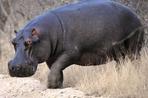
The Hippopotamus a massive, semi-aquatic mammal with a mass of up to 2, 5 tonnes. The Hippopotamus is typically a slate brown colour to muddy brown, with purplish hues often visible.
A massive animal, it measures 1500mm in height at the shoulder and has a length of 4310-5160 mm, of which about 560mm is tail. The eyes and nostrils protrude, allowing the animal to see and breathe while otherwise submerged in the water.
A Hippo's teeth are shown in yawning to warn potential competitors and are used for self defense from each other or enemies. The teeth are the hippo's most valuable weapon and can bite a medium-sized crocodile in half.
Diet
What do Hippos eat?
The Hippopotamus is strictly a vegetarian. They require a large amount of energy and therefore need a food source that is in rich supply. If they were carnivorous, there would be more competition for food, thus requiring more energy to get it.
Its diet consists mainly of terrestrial grasses and they may eat up to 68 Kg of grass a night. At dusk, Hippopotamuses leave the water and sometimes walk as far as 8km inland to graze on short grass, which is their main form of sustenance.
The 2 essential requirements of a hippo is water deep enough to submerge in and a good supply of grassland nearby.

Breeding
Breeding occurs in water where large males are buoyant and their weight and size aren't fatal to the cow. This could also be dangerous for the male as his hind legs on their own aren't strong enough to support him. The male becomes very aggressive during this act and will often lash out or attack other bulls that are close by (sometimes including the young male offspring of the concerned cow).Behaviour
Hippos are usually found in large social groups called rafts, of which there is one male and many females and their young. Dominant males are very territorial, but will occasionally accept other males as long as they are submissive and show no interest in the females.
They sleep in or alongside the water during the day and at night forage for grass close to the water. They are strong and fast swimmers, and will attack when wounded or agitated. The fact that it is responsible for most human fatalities and injuries in the wilds renders the hippo the most dangerous mammal in Africa.
It is a myth that the mother carries her calf. What happens is that in cold conditions a young hippo will rest the front part of the body onto that of an adult to sunbathe, due to their smaller body mass the young body will heat faster than adults.

Habitat
The preferred habitat of this species is deep water with adjacent reed beds and grasslands.Vital Statistics
- Weight (Female)
- 1 400kg
- Weight (Male)
- 1 800kg
- Gestation Period
- 8 months
- No of Young
- 1 calf
- Sexual Maturity
- 4 - 7 years
- Birth Weight
- 30 kg
- Order
- Artiodactyla
- Family
- Hippopotamidae
- Breeding
- A single young is born anytime during the year after a gestation period of 7 - 8 months.
Spoor (Trail) Description
There are 4 rounded toes on each foot, the tips being encased in a horny hoof. Each track ranges from 230 - 280 mm in length. The tracks do not resemble those of any other species.
See more info on the Hippo
